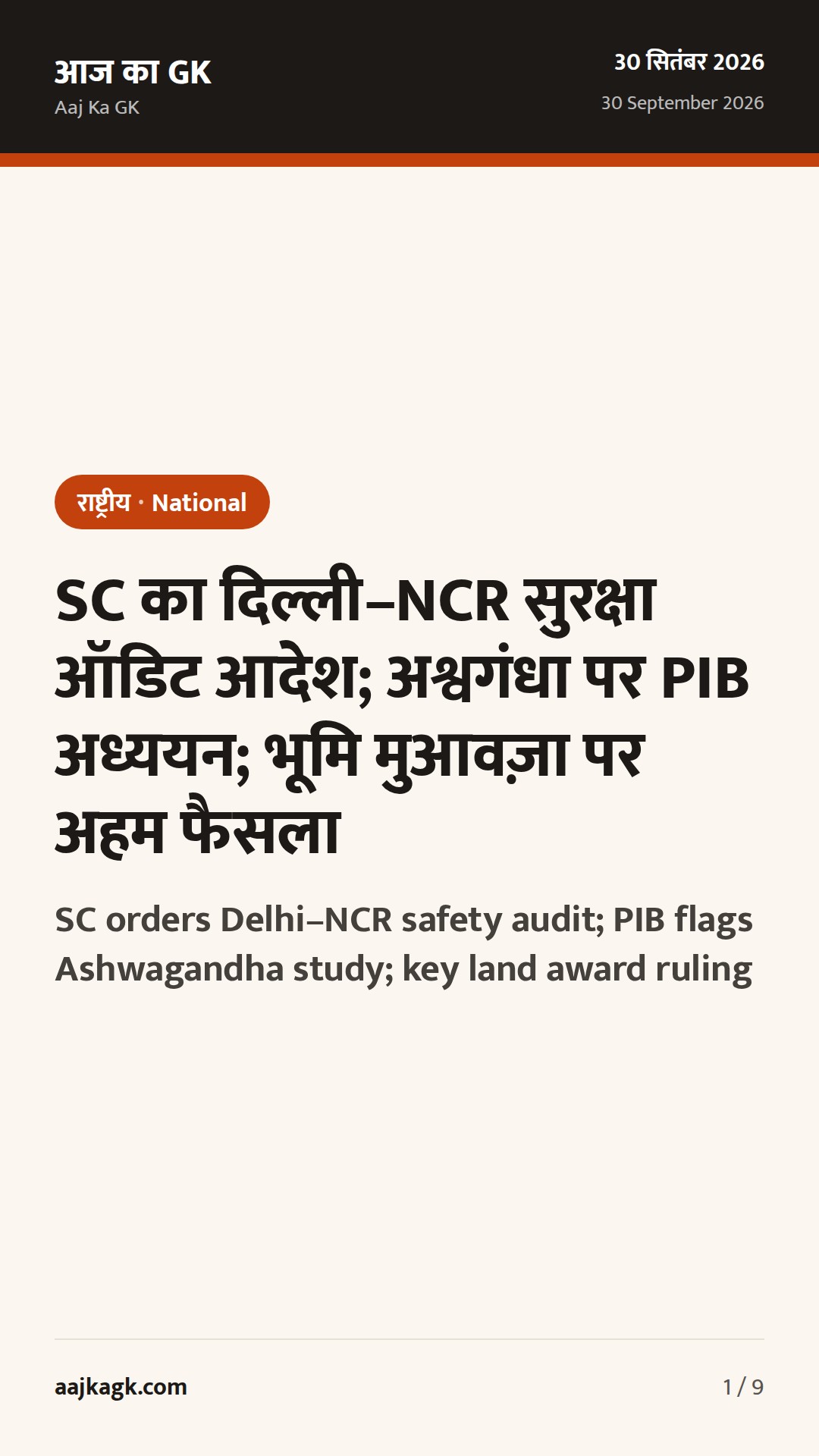
SC orders Delhi–NCR safety audit; PIB flags Ashwagandha study; key land award ruling
Top 3 national updates (Sep 28–29, 2026): SC directs a 4‑week safety audit in Delhi–NCR; PIB cites a 24‑week study on Ashwagandha safety; SC clarifies uniform compensation for contiguous land.
⭐ Key Points
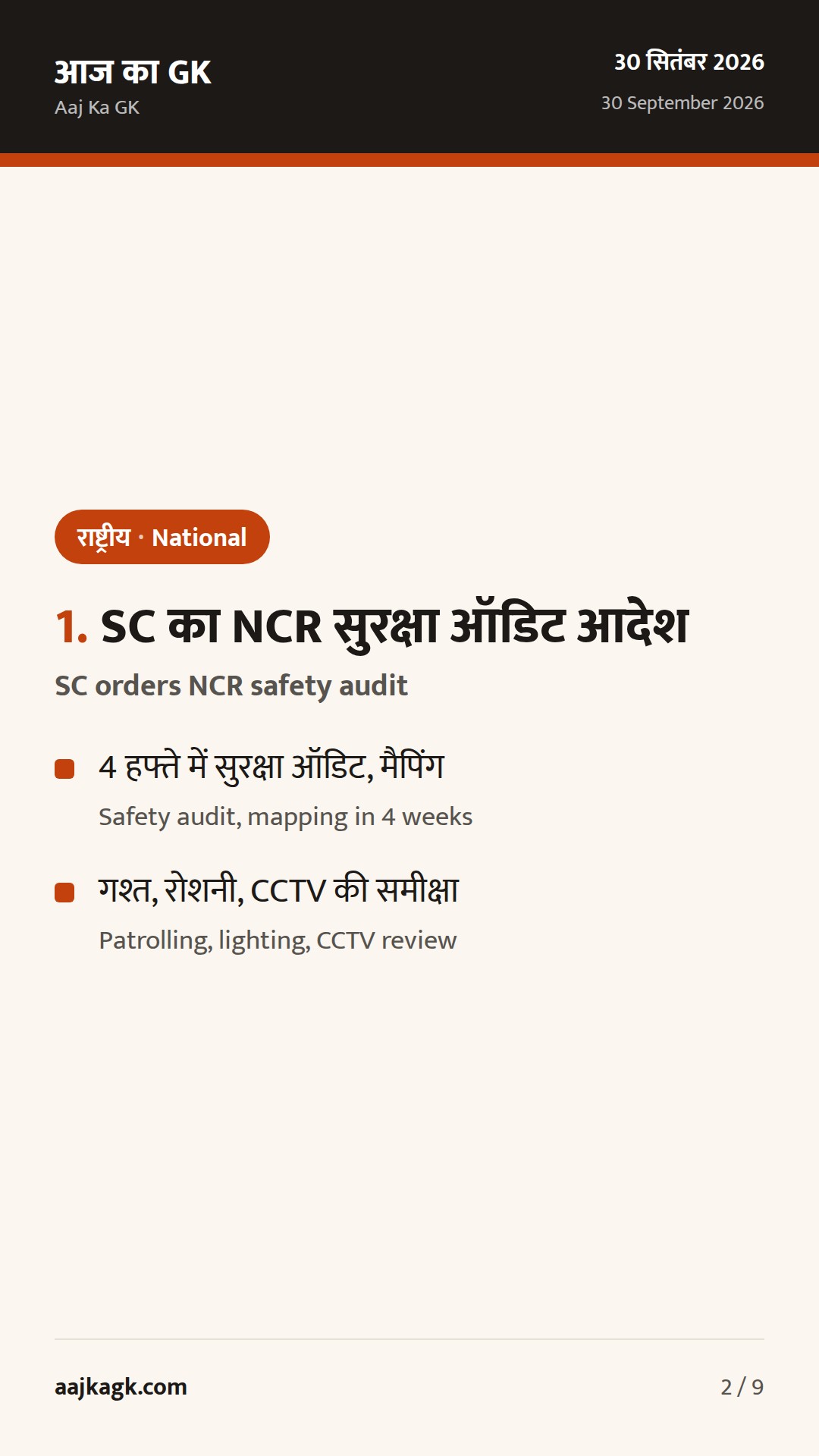
- SC directed a 4‑week safety audit and vulnerability mapping in Delhi–NCR on Sep 28, 2026.
- Status reports sought on helplines, response times and survivor support systems.
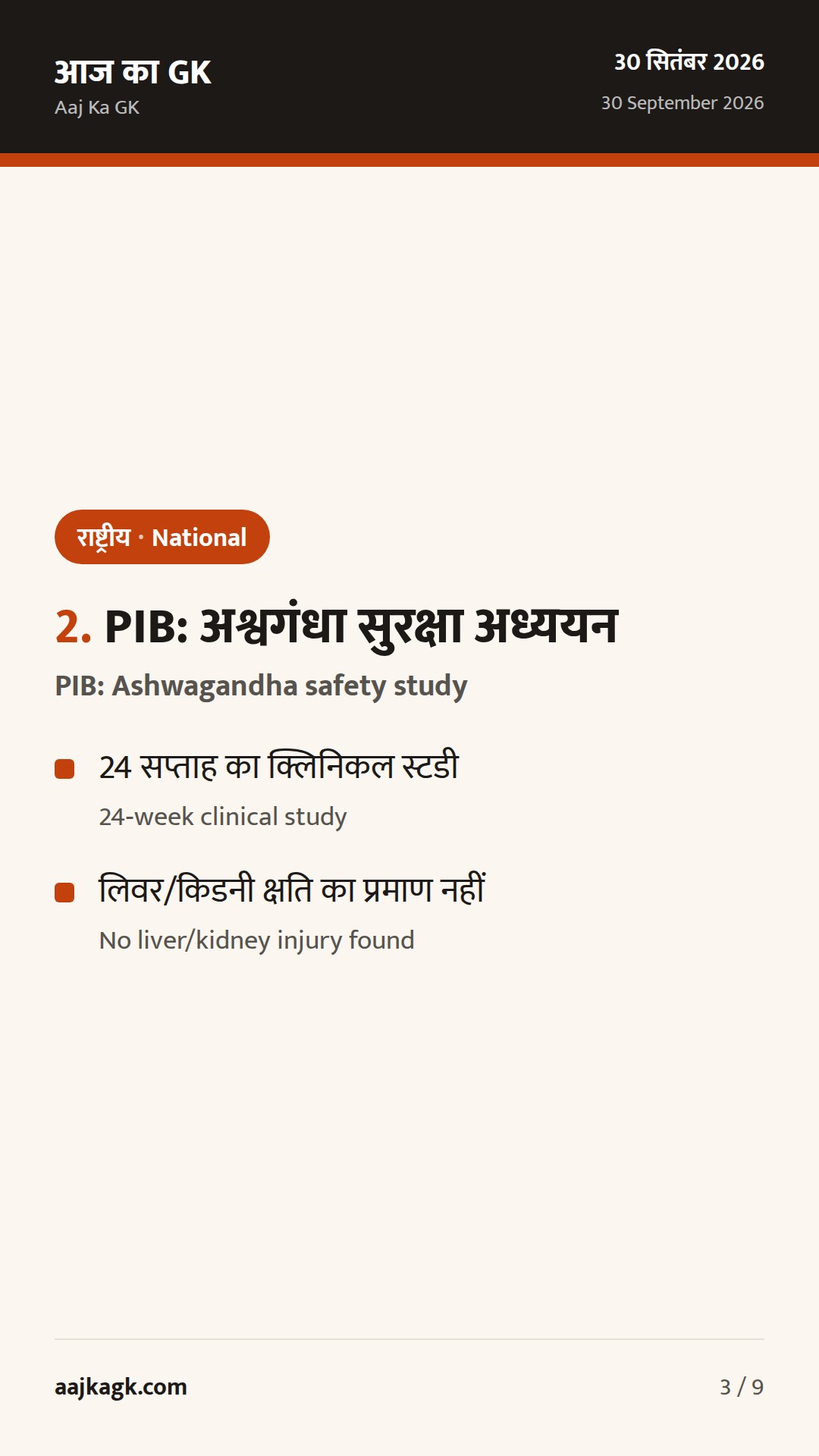
- PIB (Sep 28): 24‑week study found no liver/kidney injury with standardised Ashwagandha root extract.
- Highlights the need for standardisation and pharmacovigilance in herbal products.
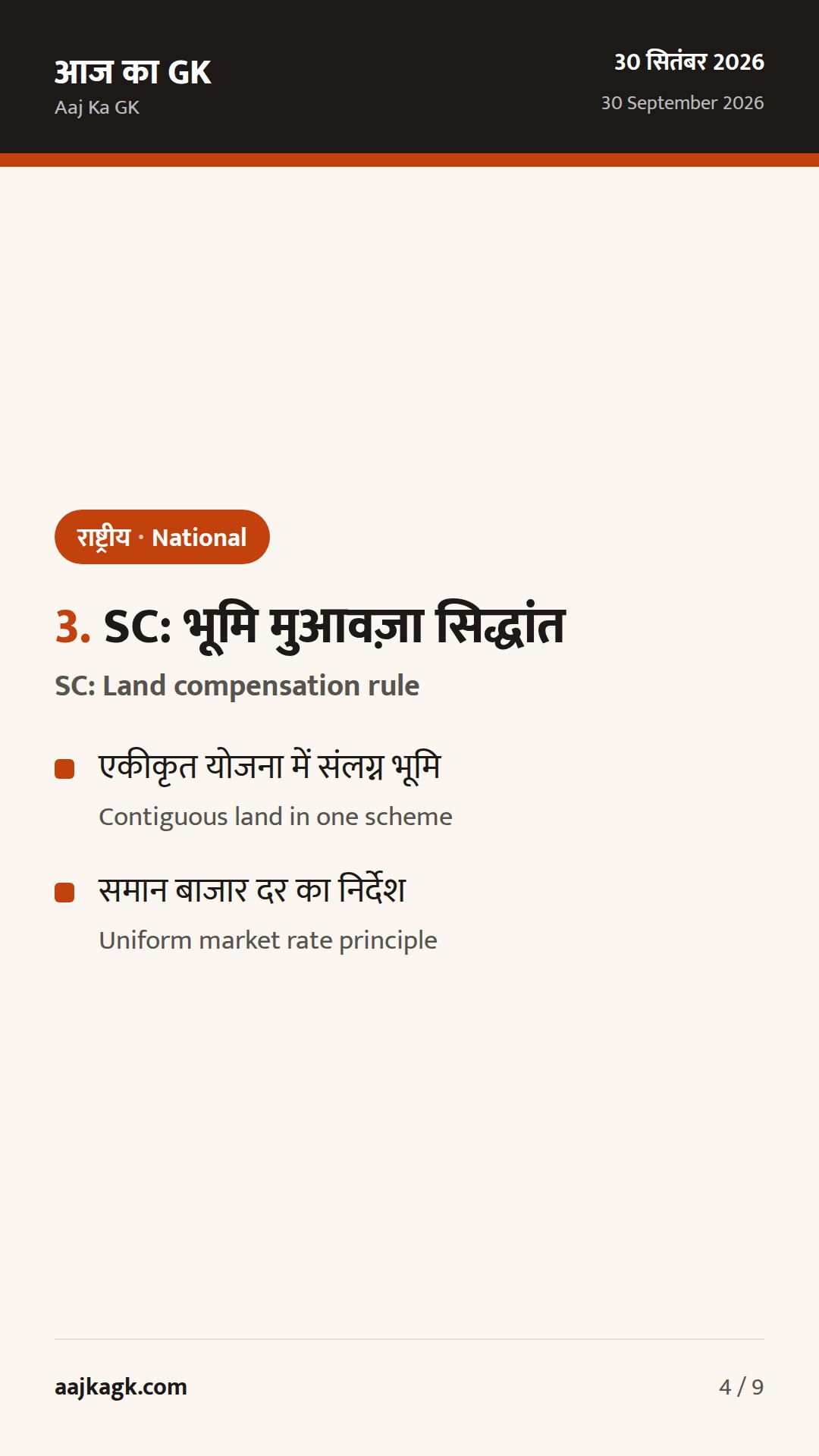
- SC (Sep 29): Contiguous land under one scheme should get uniform market compensation absent material differences.
- Reaffirms equality (Art. 14) and just compensation in land acquisition.
- Urban governance synergy is a key exam theme (police–municipal–transport).
- AYUSH research outputs inform policy and consumer safety standards.
1) Supreme Court: 4‑week safety audit across Delhi–NCR
What happened
On September 28, 2026, the Supreme Court took suo motu cognisance of recent sexual assaults in Delhi–NCR and directed Delhi Police and civic bodies to complete a safety audit within four weeks, map vulnerable spots, strengthen lighting/CCTV, and intensify patrolling. The Court also sought status reports on the functionality of helplines, emergency response times and survivor support systems.
The Bench comprised Justices J. B. Pardiwala and K. Vinod Chandran.
Sources: LiveLaw; Business Standard
Background
Incidents (including the September 21 Astha Kunj Park case) triggered judicial scrutiny of urban safety systems. The SC often uses suo motu powers to fix accountability across police, municipal and welfare authorities.
Why it matters for exams
- Suo motu powers under Articles 32/142—policy directions and accountability mechanisms.
- Urban governance synergy: police–municipal–transport coordination for public safety.
- Women’s safety schemes: 181 helpline, One-Stop Centres, Nirbhaya Fund—need for integrated response.
2) PIB: 24‑week clinical study finds no liver/kidney injury with standardised Ashwagandha root extract
What happened
A PIB entry dated September 28, 2026 (AYUSH/AIIA) reports that a 24‑week clinical study observed no evidence of liver or kidney injury with a standardised Ashwagandha (Withania somnifera) root extract. The finding underscores the importance of quality control and evidence-based use of traditional medicines.
Source: PIB—September 2026 list (AYUSH entry, 28 Sep 2026)
Background
Ashwagandha is a widely used Ayurvedic herb. Safety concerns around herbal supplements globally make standardisation and clinical evidence essential for policy and regulation (FSSAI/AYUSH).
Why it matters for exams
- AYUSH and research: push for evidence-based Ayurveda.
- Standardisation vs crude preparations—links to safety/efficacy and labelling.
- Public health regulation: pharmacovigilance and consumer protection for herbal products.
3) Supreme Court: Uniform compensation for contiguous land acquired under one scheme
What happened
On September 29, 2026, the SC clarified that where land parcels are contiguous and acquired under a single integrated project, and there are no material distinctions, compensation should generally be determined at a uniform market rate. The case arose from acquisition in Fazilka district, Punjab, for the Aspal Extension Drain.
Sources: LexStreak; LawLens—SC Sept 2026 updates; SC Latest Orders
Background
Disparities in land awards often trigger litigation. The ruling aligns compensation principles with Article 14, discouraging artificial distinctions among similarly situated plots within one scheme.
Why it matters for exams
- Land acquisition valuation: comparable sales, belting, and judicial standards.
- Constitutional law: equality and just compensation principles.
- Administrative process: notifications, evidence appraisal, appeals.
Quick revision
- SC (Sep 28): 4‑week safety audit; mapping, patrolling, and functional helplines in Delhi–NCR.
- PIB (Sep 28): 24‑week study—no liver/kidney injury with standardised Ashwagandha extract.
- SC (Sep 29): Uniform compensation for contiguous land acquired under one project.
Important Facts for Exams
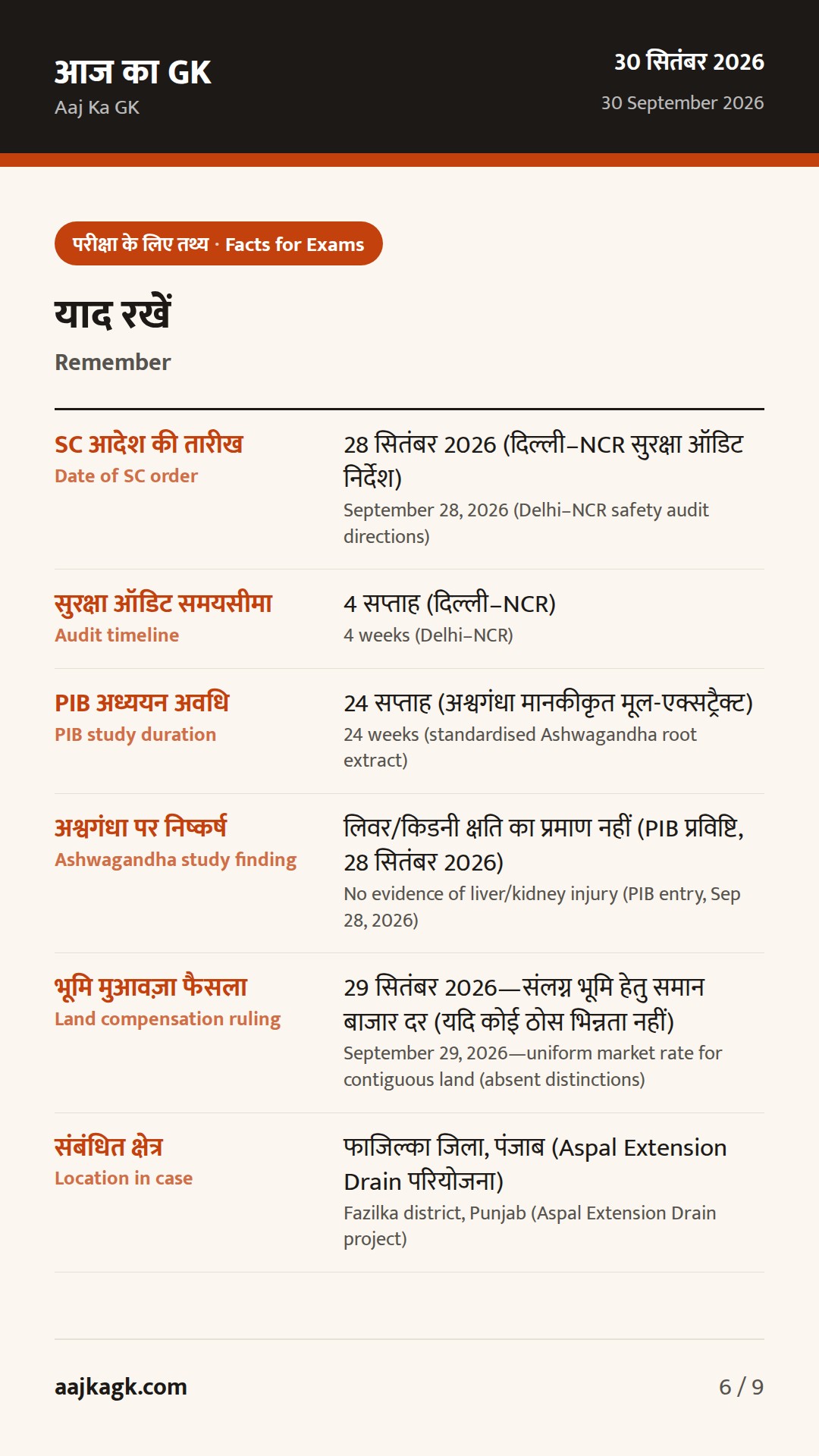
| Date of SC order | September 28, 2026 (Delhi–NCR safety audit directions) |
|---|---|
| Audit timeline | 4 weeks (Delhi–NCR) |
| PIB study duration | 24 weeks (standardised Ashwagandha root extract) |
| Ashwagandha study finding | No evidence of liver/kidney injury (PIB entry, Sep 28, 2026) |
| Land compensation ruling | September 29, 2026—uniform market rate for contiguous land (absent distinctions) |
| Location in case | Fazilka district, Punjab (Aspal Extension Drain project) |
| Bench (safety matter) | Justices J. B. Pardiwala and K. Vinod Chandran |
| Relevant Articles | Arts. 14, 32, 142 (equality and SC’s wide powers) |
Practice Questions (MCQ)
👆 Tap an option — you'll instantly see if it's right or wrong.
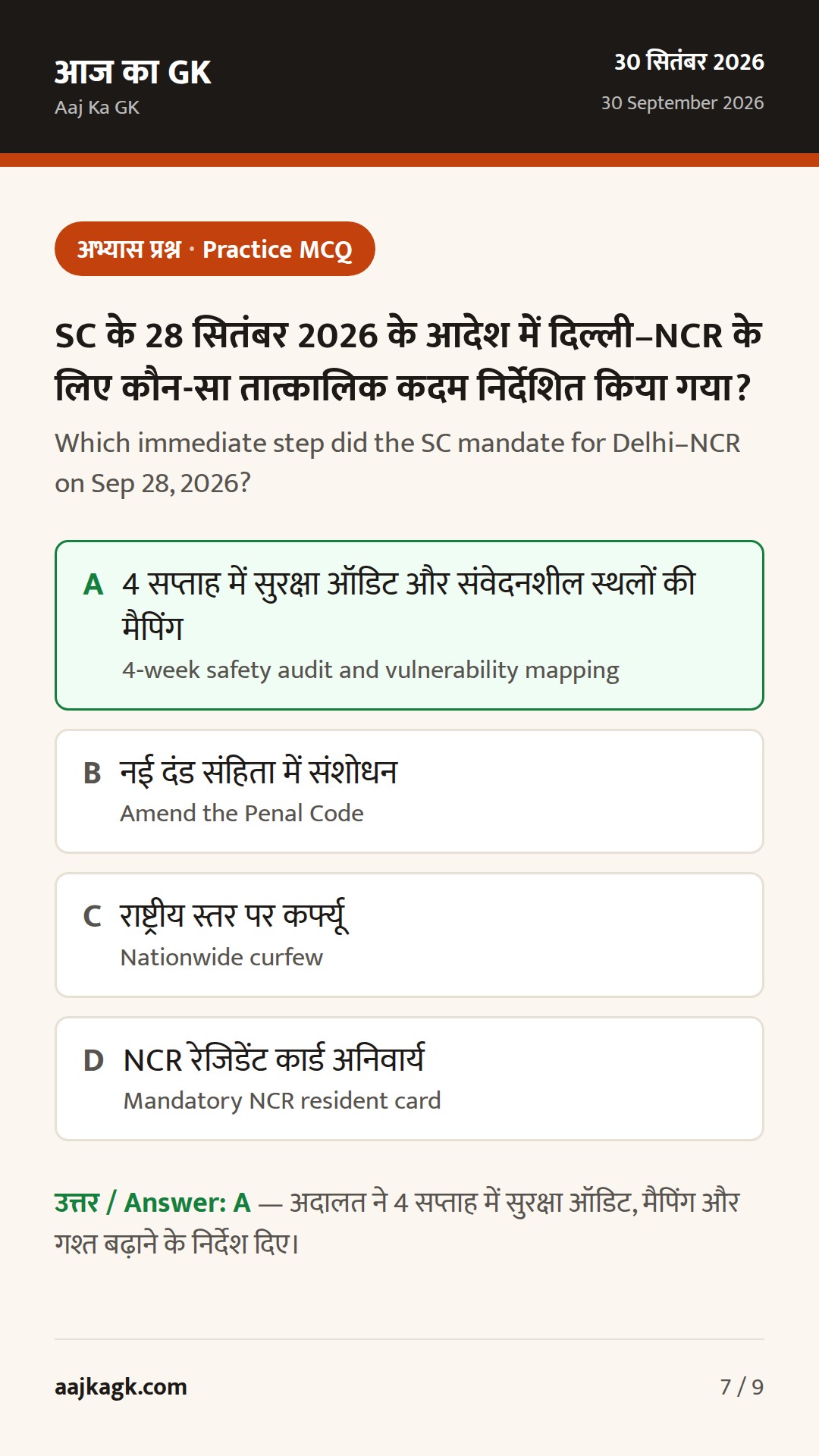
Q1 Which immediate step did the SC mandate for Delhi–NCR on Sep 28, 2026?
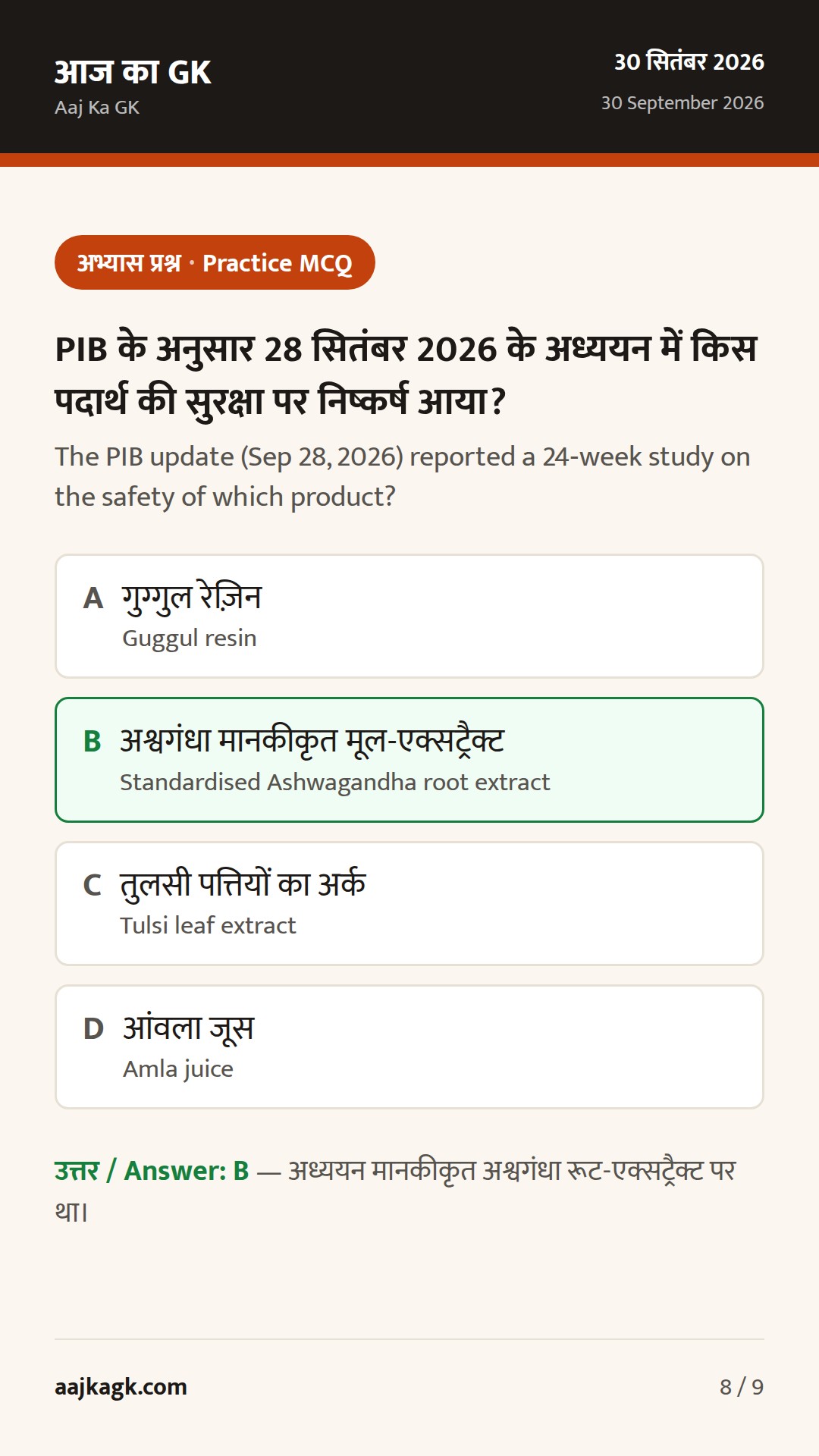
Q2 The PIB update (Sep 28, 2026) reported a 24‑week study on the safety of which product?
Q3 What compensation principle did the SC reiterate on Sep 29, 2026?
Q4 Which bodies were asked to coordinate in the Delhi–NCR safety matter?
Q5 Why is the Ashwagandha study relevant for policy?
Sources